Showing posts with label Petroglyph. Show all posts

Monday, October 25, 2021

Bandelier National Monument

Visiting historic sites has always been a passion. If there are such areas near my vacation destinations, I make it a point to seek them out and pay a visit. I call myself an old soul living in present times. 

While visiting New Mexico, the Bandelier National Monument was one such. 


Arriving there on a cold November morning, these cliffs with arid vegetation did not quite give an idea of what to expect.

After crossing a wooden log bridge, and walking a few hundred yards, what waited ahead was a spectacular sight!

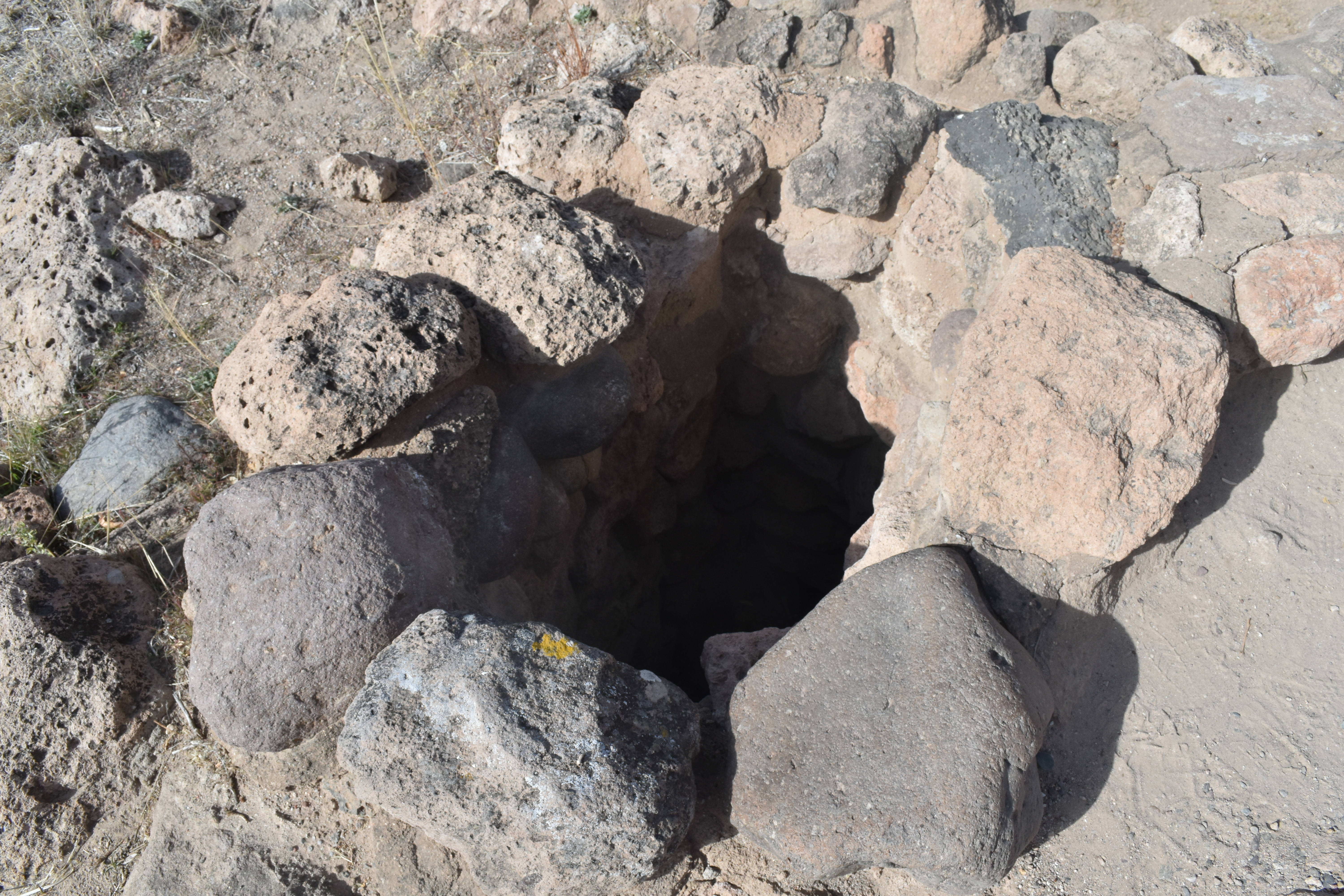
A huge cauldron lined by bricks with some arrangements at the center greeted visitors. It was enough to get me hooked. It is believed that this is Ancestral Puebloans aka Anasazi territory, and they inhabited the region between 1150- 1600 AD. 

Closeup of a circular arrangement.

Another view of the big cauldron/well. 

Another smaller stone lined dugout. It is a large area of such built up structures just adjacent to the mountain face, where the dwellings are located. 

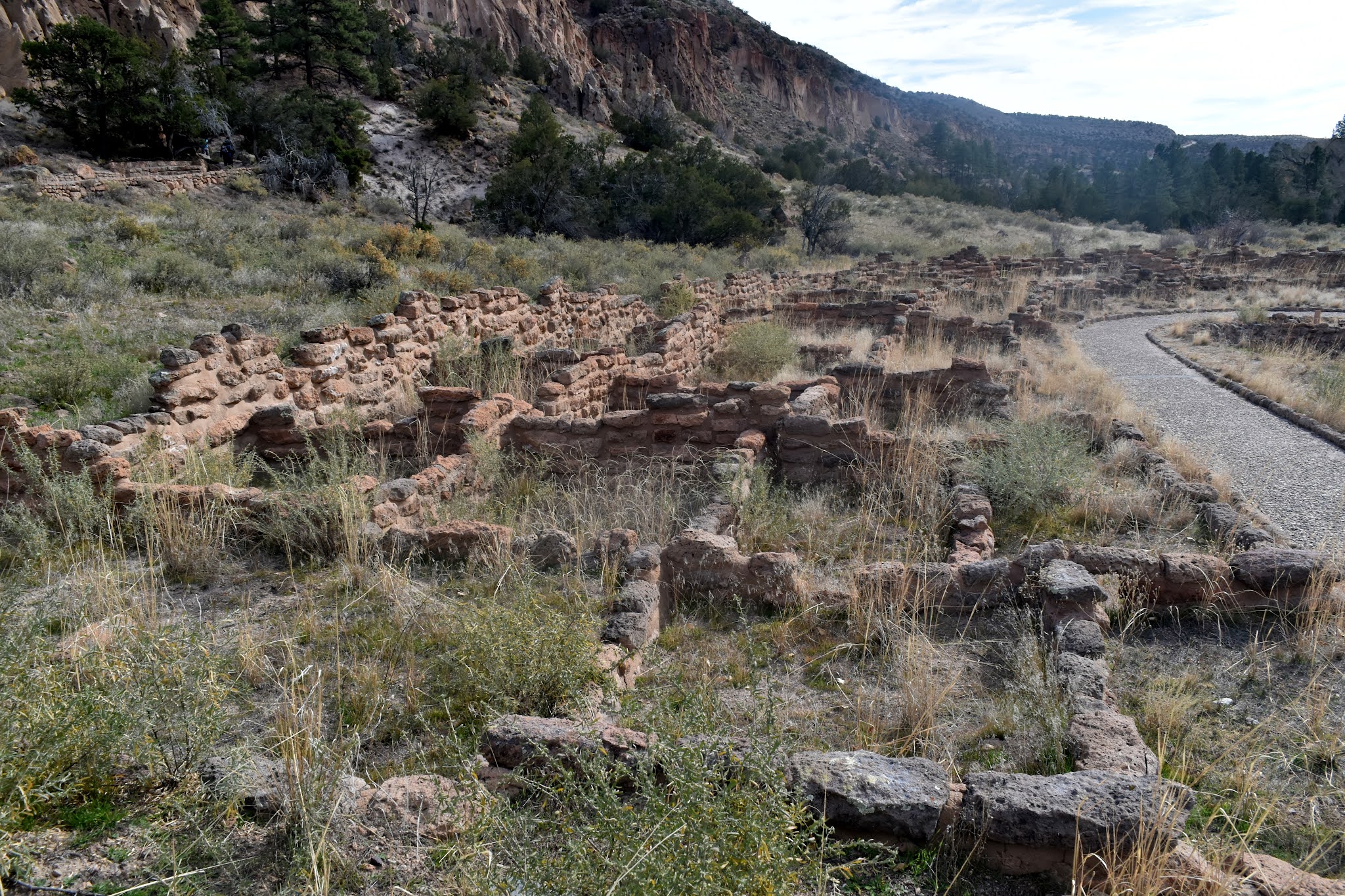
As you make your way up to get to the cliffs, you encounter these well marked rectangular 'rooms' arranged in a circular pattern. Known as Tyuonyi ruins, it is an archaeological site, and once stood 1-3 stories tall. It is fascinating to see this precisely laid out design.

From a vantage point as one climbs higher to get to the living quarters, a look back gives a good perspective of the scale of things.

What you are walking towards is this face of the mountain. Volcanic ash consolidated to form porous tuff, along with shale, sandstone, and limestone from different eras gave the Puebloans a variety of materials to work with. 

Stones and wood were used to build 'homes' in the mountain, and the rock itself was carved out to make cave like shelters. 

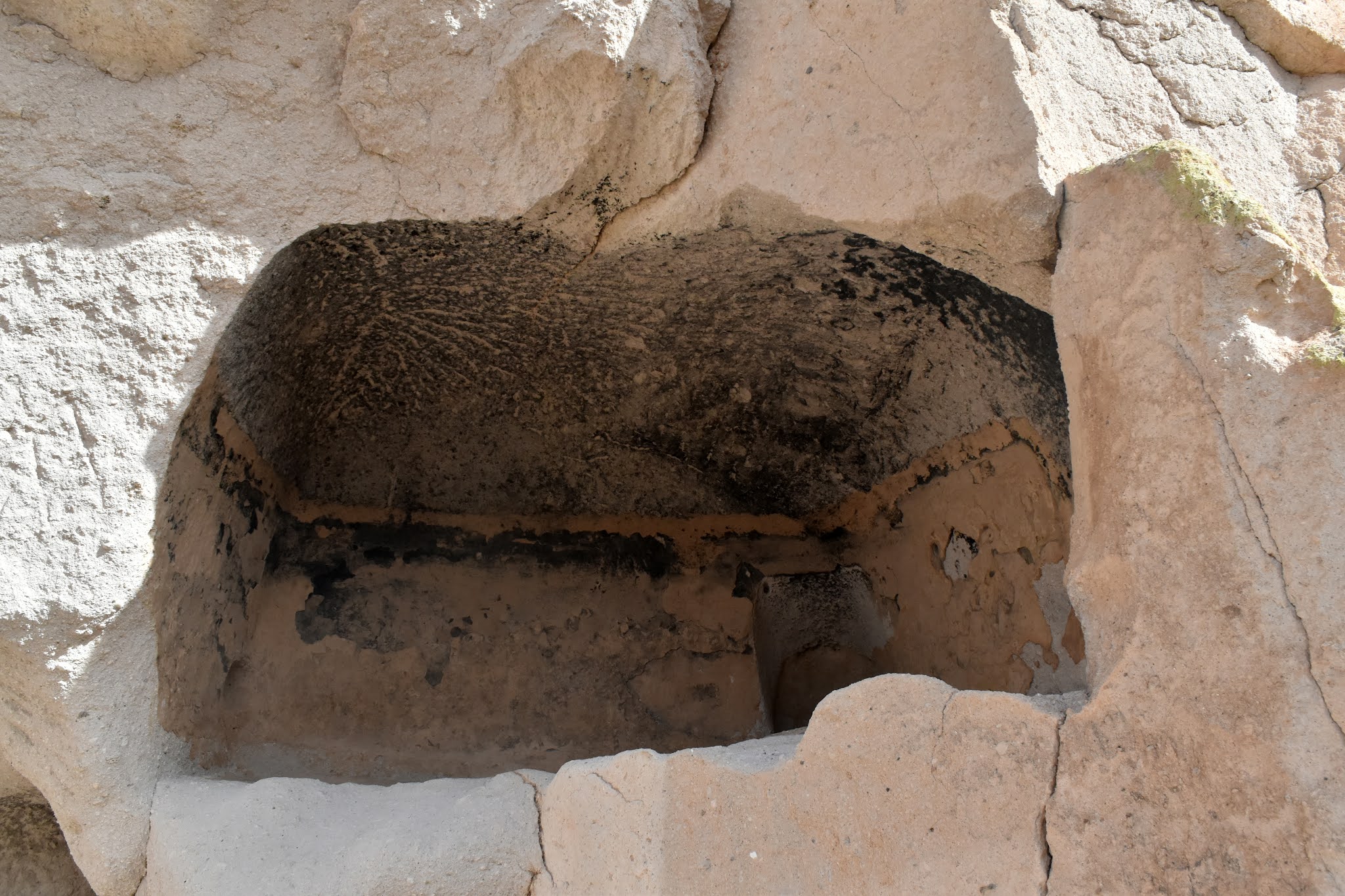
The dwelling from the inside. Neat workmanship. 


One of the many areas in the face of the mountain that were used for shelter. Soot on the roof suggests that fires were lit in there. 

Another view of the inside of a 'cave'. 

Big ladders are placed at the doors to the homes. You have to climb up and get in. The ladder was then probably pulled up into the house. This might have served a dual purpose, to hide from enemies and limit their access to the home, and hide from predators too. 
I got inside and sat at the window looking down at the 'street' as some of the people who lived here might have done hundreds of years ago. 

Another look at down below from one of the 'windows'. 

Some more dwellings at ground level. Some neat arrangements of rocks, probably a garden?

Petroglyphs are found on the rockface in some parts. 

Some more artwork by the Pueblo people.

It is truly incredible to visit and know that people lived and walked around here all those years ago. There seems to be a systematic plan they followed as they built this community. 

Closeup of the art preserved at the site. A very southwestern pattern, and I wonder if studies have been done on deciphering these symbols found here. 

Another look at the face of the ridge. 

Dramatic geological features here!

After being thoroughly intrigued by walking through the monument and soaking it all in, it was time to leave. 
On the drive back to Santa Fe, near White Rock, one sees San Ildefonso Pueblo pottery on exhibition by the side of the road. These huge replicas of traditional pottery were part of a project. 

They are eye catching and stand out yet blend with the landscape. More about this can be read here.


Wednesday, November 22, 2017

Kasha-Katuwe Tent Rocks National Monument

A recent visit to New Mexico made me realize how much I had undervalued what the beautiful state had to offer to a visitor. From a desert near the southern end to snow-capped mountains to the north, there is a vast variety of landscapes one can explore.

**Please click on the pictures to view full screen in better resolution**

To the west of the charming town of Santa Fe, lies this unusual geographical wonder among the mountains, the Kasha-Katuwe (meaning white cliffs in native pueblo language) tent rocks.

Kasha-Katuwe Tent Rocks National Monument, New Mexico

The monument is open to the public and a hike of about 4 miles from start to finish takes you through an amazing trail. You can also do a shorter and easier mile long Cave Loop trail, but the Slot Canyon Trail is the one that really packs the punch.

A first closeup look at the formations from the Cave Loop Trail.

Kasha-Katuwe Tent Rocks National Monument, New Mexico

The cave that the trail is named after.

Cave Loop trail at Kasha-Katuwe Tent Rocks National Monument, New Mexico

There are portions of this trail that climb gradually and at about the half mile mark, you see the Slot Canyon trail take off.

Kasha-Katuwe Tent Rocks National Monument, New Mexico

Erosion and weathering of huge deposits of volcanic rock have resulted in teepee shaped structures or tents. The tents are actually softer pumice and tuff and at the base are tougher caprocks. 
There are hoodoos too, among the tents.


The Slot Canyon Trail starts on a fairly even terrain and then it meanders over rocks, providing some excellent views of the tent rocks.

Kasha-Katuwe Tent Rocks National Monument, New Mexico

I had read about petroglyphs in some areas of New Mexico, and hoped I would get to see some. When I walk trails, I do it at my own pace, looking for wildflowers, wildlife, and anything interesting. At one point, when I was admiring a beautiful Juniper, I became aware of a gentleman in khakis and a white shirt, with a hiking hat and camera, standing nearby. 
He watched me admiring the tree and asked- "Did you see that petroglyph"? 
Completely taken by surprise, I mumbled- "What? Where?"
"Right there on that cave wall", he pointed. 
Sure enough, much to my delight, was a drawing, made by some unknown person who lived there hundreds of years ago! 
Not many people knew of the existence of that petroglyph there that day. How fortunate that the gentleman who did know had to cross paths with me at the exact spot where there was one! 
I think it depicts a large snake on the right, and a smaller one on the left, along with some other designs.
I thanked the man for telling me about it, and asked if he knew of more in the area. He said that was the only one at Kasha-Katuwe that he knew about. 

Petroglyph at Kasha-Katuwe Tent Rocks National Monument, New Mexico

The trail then leads to a narrow passage between the slot canyon. 

Slot Canyon at Kasha-Katuwe Tent Rocks National Monument, New Mexico

For those not fond of small spaces, this portion could pose a challenge. I am sometimes uncomfortable in such places, but this did not bother me.

Slot Canyon at Kasha-Katuwe Tent Rocks National Monument, New Mexico

The path then passes under this boulder, 

Slot Canyon at Kasha-Katuwe Tent Rocks National Monument, New Mexico

and opens up to begin a steep climb up the canyon. It mostly has sand and rocks on the path that you use as stepping stones.
The tent rocks at this point are above eye level.

Kasha-Katuwe Tent Rocks National Monument, New Mexico

As you start to climb up, you view the tents at eye level.
Here, for a brief portion of the trail, railroad ties as steps help get you several feet up.

Kasha-Katuwe Tent Rocks National Monument, New Mexico

When you get to the top finally, you see the formations way below. At each level, they offer a different and very interesting perspective.

Kasha-Katuwe Tent Rocks National Monument, New Mexico- View from the top

The views from the top are spectacular! Sangre de Cristo and Jemez mountains in the distance and hoodoos and tent rocks below make the climb up totally worth it!

Hoodoos and mountains at Kasha-Katuwe Tent Rocks National Monument, New Mexico

Another view from the top showing hikers on the trail- it gives you an idea of what you've accomplished. For me, this was a personal challenge. Nobody asked me to do it, and I could have stopped at any point, but I decided to go one step at a time. Though I was slower than some others, I got to the top in good time. It did wonders for my confidence. Until last year, walking and hiking did not pose a challenge, but plantar fascitis and other issues made me not so sure of myself lately. This climb of about 700 feet (per alltrails) was a good endurance test.